HDSB schools win top honours at inaugural AgRobotics Student Challenge
Milton District High School and Abbey Park High School made waves in the agricultural technology world at the first ever AgRobotics Ontario Challenge, a new educational robotics competition designed to engage high school students in solving real-world problems facing modern agriculture.
Out of the six selected finalists, five displayed their prototypes at the Western Fair Association's London Farm Show on March 5, 2026. Of the six schools selected to compete, Milton District HS took home first place and Abbey Park HS received second place.
Milton District HS - LifeLoop
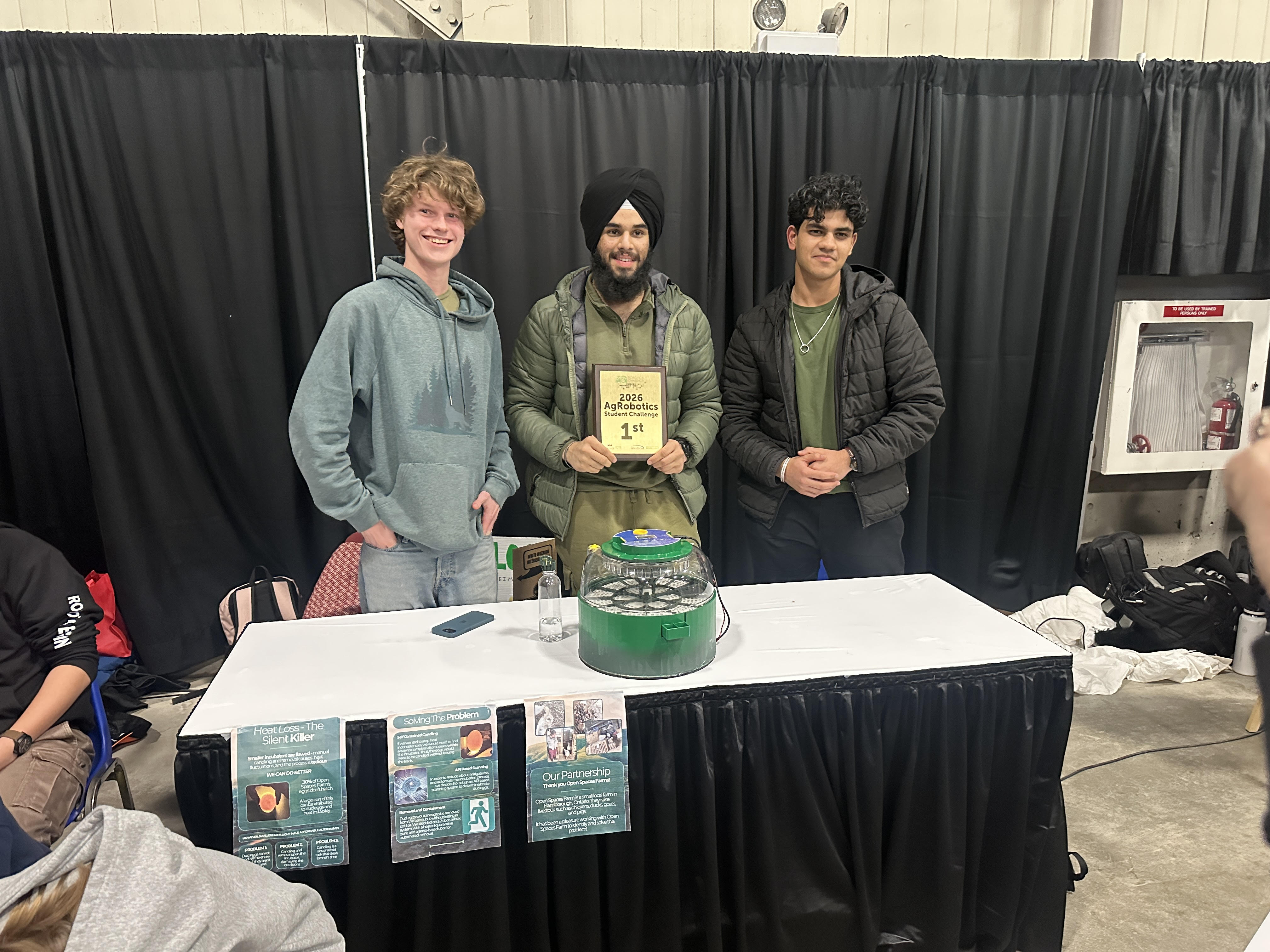
Left to right: Graylon Wawrzyniak, Angad Sandha, Aarnav Sehgal
Open Spaces Farm, a small self-sufficient homestead in Flamborough, Ontario, plays a vital role in its local community by supplying eggs, meat and livestock. It was also the inspiration for Milton District HS’s award winning innovation, after a visit to the location led students to identify the farm as a strong representation of the challenges faced by small agricultural operations. One key issue emerged in the egg incubation process, where farmers must manually inspect eggs through a method called candling to identify non-developing “dud” eggs. This labour-intensive process not only consumes valuable time but also requires opening the incubator, causing temperature drops that can harm developing eggs. As a result, small scale egg farms report an average hatch rate of only 70%, with dud eggs posing risks of contamination and loss for the remaining viable eggs.
In response, MDHS students developed LifeLoop, a device aimed to modernize incubation by automating candling, monitoring and the removal of dud eggs within a closed, climate-controlled system. The design features a rotating conveyor that moves eggs past internal lighting and camera systems, where AI analyzes their development. Faulty eggs are automatically separated into an airlock chamber, preventing disruption to temperature and humidity levels. Powered by a central control system and supported by sensors, motors and a mobile app for remote monitoring, LifeLoop reduces manual labour while improving consistency and hatch rates. Beyond Open Spaces Farm, the innovation addresses a broader gap in affordable automation for small and mid-sized farms, offering a scalable tool to enhance efficiency and reduce losses across the agricultural sector.
The students plan to invest their prize money from the competition to continue to refine their product, hoping to one day bring it to market.
Abbey Park HS - BuzzRover
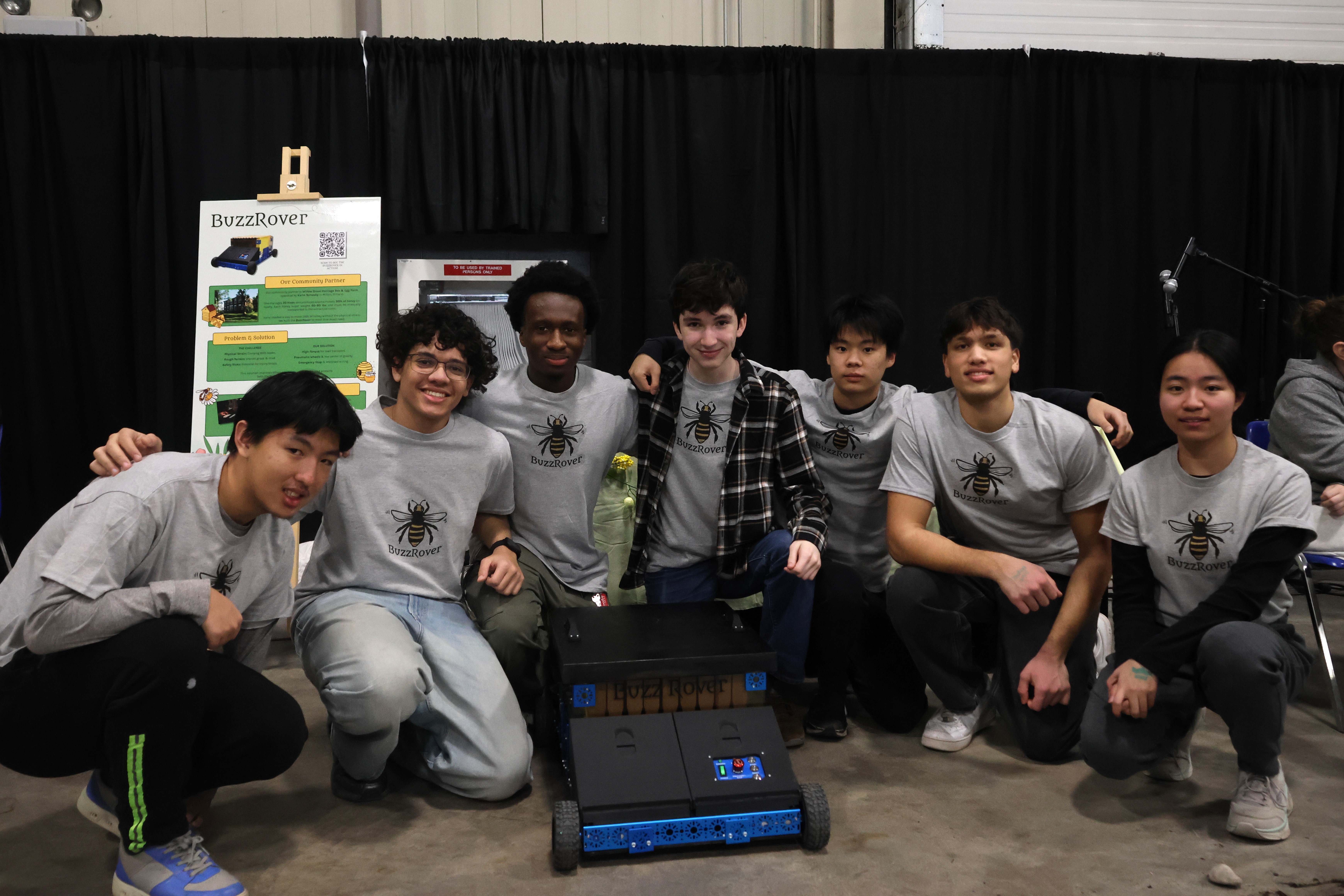
Left to right: Duke Liu, Ruvan Sidrake, Lusako Mwakatobe, Jamie Peacock, Bora Chen, Khelan Tailor, Sutong Zhang
BuzzRover is an autonomous, remote-controlled transport rover developed by a team of students from Abbey Park HS in collaboration with Willow Grove Heritage Bee & Egg Farm to address the physically demanding and inefficient process of moving heavy honey supers, wooden boxes added to beehives to collect honey, during harvesting.
Designed specifically for small-scale beekeeping operations, the rover improves workflow by safely transporting loads of up to 60–80 pounds across uneven outdoor terrain, reducing strain on farmers and minimizing product damage. It features a durable yet lightweight aluminum frame, four-wheel skid-steer drivetrain powered by high-torque DC gear motors and a stable low center of gravity for safe operation.
The system includes a removable plexiglass containment unit to secure and monitor honey frames, a weather-resistant 3D-printed enclosure for electronics and a modular design that supports easy maintenance and future upgrades. Powered by NiMH batteries and controlled via a remote interface with path-recording capabilities, BuzzRover combines efficiency, safety and sustainability to provide a practical agricultural robotics solution that enhances productivity while supporting environmentally conscious farming practices.
New perspectives on tech and industry
Opportunities like AgRobotics highlight how HDSB students are engaging in meaningful, hands-on learning that makes a real impact.
“This competition provided my Computer Engineering students with an opportunity to connect with a community partner and apply their classroom learning to a real-world problem,” says Stephanie Gigg, a teacher at Abbey Park HS. “It challenged them to think critically, solve complex issues and build future-ready skills that will serve them well beyond the classroom.”
Students from both schools emphasized the value of experiences like AgRobotics, not only for bringing their learning to life, but also for expanding their understanding of potential career paths.
“When students think about robotics and future careers, they don’t always consider its role in agriculture,” says Kristina McGill, a teacher at Milton District HS. “AgRobotics opened their eyes to a new side of technology, showing how it can drive innovation in agriculture and helping them make meaningful connections to future pathways and careers in Canada.”


